DONATE -- click on this link
Kirinda Puhulwella to Deiyandara
Kilometers: 18 Elevation gain/loss: 401m/373m
Most of Sri Lanka enjoys rolling power cuts for several hours a day. A country-wide drought has dried up the flow at the hydro-power plants that generate the majority of the island's electricity. You would not think there is a dfought to look at all the lush greenery which cloaks this part of the world, certainly not here in the south-west, where occasional sprinkles have deceptively kept everything looking verdant and tropical and fertile. Go east a few kilometers, or north, and the cracked earth, withered crops and empty riverbeds tell the real story. Monsoon has failed, barely smattering the country with a fraction of the usual rainfall and everyone is feeling the effects.

Now, after months of clear skies, and perfectly timed to the start of my walk, the weather has turned. Forecasts for the next 10 days say rain, rain and more rain. So much rain I thought the websites I was checking were having technical difficulties. But no. Satellite pictures showed huge swathes of cloud over the island, and report after report confirmed it would be a wet week ahead. As I bid my hosts goodbye and set out for Deiyandara, the morning mist turned to drizzle, drizzle to showers, and showers to proper, pissing-down storm. A fine sight I must have been walking along the road, a lone foreigner, hiding a Quasimodo hunchback (the Marquise de Sade backpack) under a giant red tarp poncho, soaking wet head of hair, feet sloshing in rivers of road runoff... Vanity has been completely abandoned on this walk!

The day was spent walking, then sheltering under overhanging roofs -- sometimes just diving, unannounced and uninvited, through a random stranger's front door to avoid the at-times horizontal rain -- and then plodding on again. I have since decided to coin a new term, a modification on "downpour". I am adding "sidepour" to my lexicon. Once you're wet though, you cannot get any wetter, and as my mother used to tell me, "You're not made of soap. You won't melt in the rain!"
Minutes before I had to stow my camera away from the deluge, I did happen upon one remarkable sight. A few kilometers just north of Hakmana, turn west at a small unmarked road from Denagama toward Deiyandara. The road curves around a picturesque, small dammed lake. By its shore, and spanning both sides of the road with its enourmous canopy, is a huge and amazing tree.

In its branches hundreds -- perhaps a thousand -- flying foxes, amassed in a giant swarm, more plentiful than the leaves of the tree itself, all hanging like ripe, brown, furry fruit, as the following close-ups will attest.

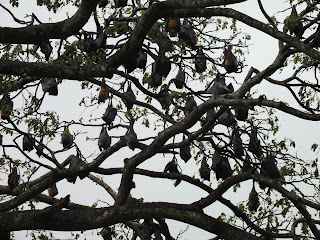
I know everyone expects the wildlife in Sri Lanka to be all about elephants and leopards, the poster children of the wildlife tourism department, but this was truly an unusual and impressive thing to behold. Perhaps it's not for you if you're the squeamish type, or have seen too many episodes of the Vampire Diaries, or don't relish the idea (or smell) of walking through guano, but if you're a lover of all nature and not just the cuddly kind, make your way here. And if you do go -- bonus -- you'll be the only one there.
Kirinda Puhulwella to Deiyandara
Kilometers: 18 Elevation gain/loss: 401m/373m
Most of Sri Lanka enjoys rolling power cuts for several hours a day. A country-wide drought has dried up the flow at the hydro-power plants that generate the majority of the island's electricity. You would not think there is a dfought to look at all the lush greenery which cloaks this part of the world, certainly not here in the south-west, where occasional sprinkles have deceptively kept everything looking verdant and tropical and fertile. Go east a few kilometers, or north, and the cracked earth, withered crops and empty riverbeds tell the real story. Monsoon has failed, barely smattering the country with a fraction of the usual rainfall and everyone is feeling the effects.
Now, after months of clear skies, and perfectly timed to the start of my walk, the weather has turned. Forecasts for the next 10 days say rain, rain and more rain. So much rain I thought the websites I was checking were having technical difficulties. But no. Satellite pictures showed huge swathes of cloud over the island, and report after report confirmed it would be a wet week ahead. As I bid my hosts goodbye and set out for Deiyandara, the morning mist turned to drizzle, drizzle to showers, and showers to proper, pissing-down storm. A fine sight I must have been walking along the road, a lone foreigner, hiding a Quasimodo hunchback (the Marquise de Sade backpack) under a giant red tarp poncho, soaking wet head of hair, feet sloshing in rivers of road runoff... Vanity has been completely abandoned on this walk!

The day was spent walking, then sheltering under overhanging roofs -- sometimes just diving, unannounced and uninvited, through a random stranger's front door to avoid the at-times horizontal rain -- and then plodding on again. I have since decided to coin a new term, a modification on "downpour". I am adding "sidepour" to my lexicon. Once you're wet though, you cannot get any wetter, and as my mother used to tell me, "You're not made of soap. You won't melt in the rain!"
Minutes before I had to stow my camera away from the deluge, I did happen upon one remarkable sight. A few kilometers just north of Hakmana, turn west at a small unmarked road from Denagama toward Deiyandara. The road curves around a picturesque, small dammed lake. By its shore, and spanning both sides of the road with its enourmous canopy, is a huge and amazing tree.

In its branches hundreds -- perhaps a thousand -- flying foxes, amassed in a giant swarm, more plentiful than the leaves of the tree itself, all hanging like ripe, brown, furry fruit, as the following close-ups will attest.


I know everyone expects the wildlife in Sri Lanka to be all about elephants and leopards, the poster children of the wildlife tourism department, but this was truly an unusual and impressive thing to behold. Perhaps it's not for you if you're the squeamish type, or have seen too many episodes of the Vampire Diaries, or don't relish the idea (or smell) of walking through guano, but if you're a lover of all nature and not just the cuddly kind, make your way here. And if you do go -- bonus -- you'll be the only one there.


